
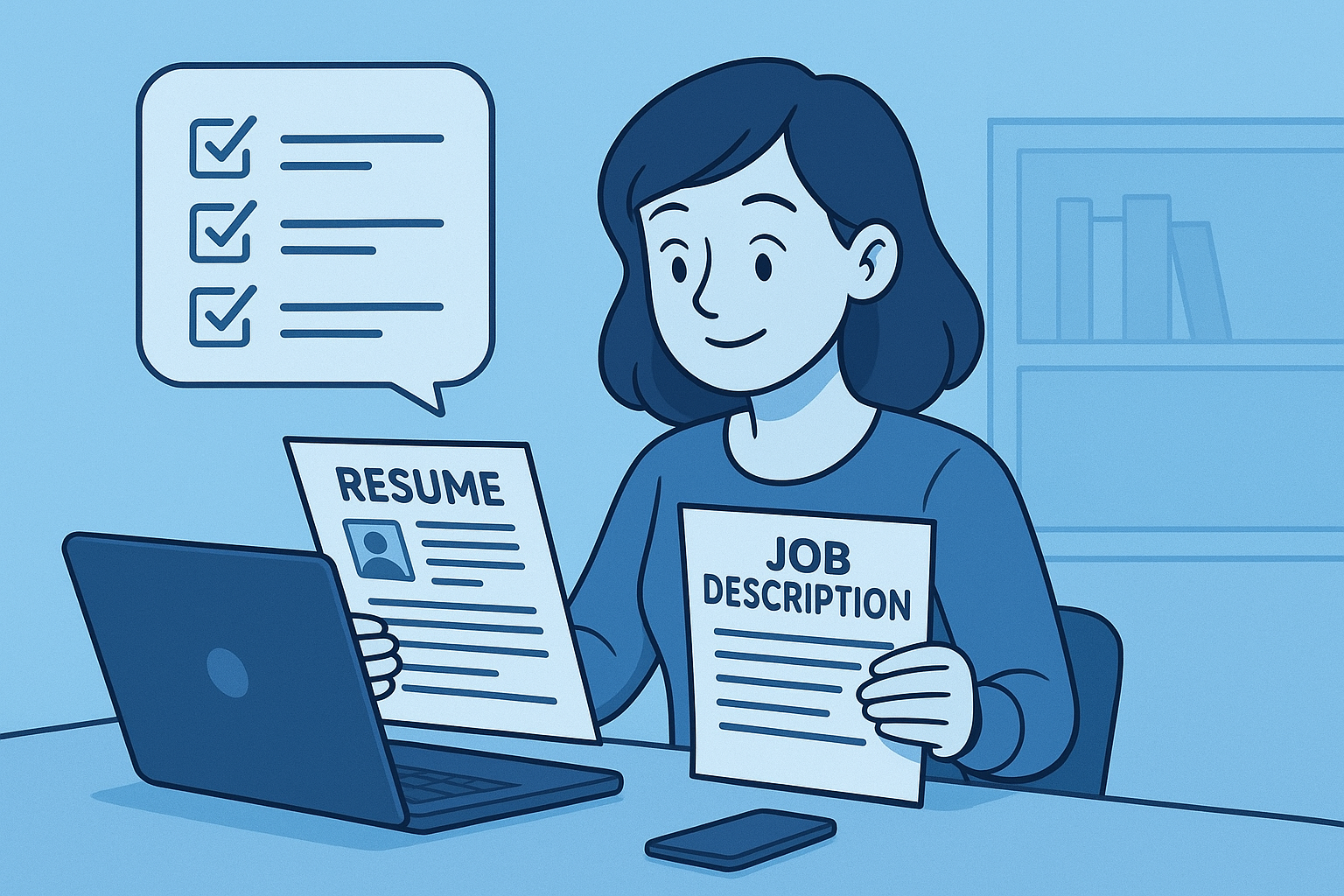

If you’ve been applying to jobs and wondering why your inbox isn’t flooded with interview requests, you’re not alone. In today’s competitive job market, sending the same generic resume to every employer is essentially burning bridges before you even build them. This comprehensive guide will teach you exactly how to tailor your resume to a job description, why it matters, and how to do it efficiently without sacrificing hours of your life in the process.
Why Should You Tailor Your Resume for Each Job?
The question “should I tailor my resume for each job?” has a straightforward answer: yes, absolutely. But understanding why is what separates candidates who get called for interviews from those who get automatically rejected.
The ATS Reality: Your First Barrier
Before a human ever sees your resume, it passes through an Applicant Tracking System (ATS). These automated bots scan your resume for specific keywords that match the job description. When you use generic language and avoid mirroring the keywords in the job posting, your resume gets filtered out before it ever reaches a recruiter’s desk.
When you tailor your resume to include the exact terminology, skills, and qualifications mentioned in the job description, you dramatically increase your chances of passing this first gatekeeping hurdle. Your resume transforms from a general document into a targeted communication tool.
The Human Reader Advantage
Beyond ATS, actual hiring managers and recruiters spend an average of 6 seconds reviewing your resume. In those six seconds, they’re scanning to see if you’re a match for their specific role. When they see that you’ve clearly customized your application to address their particular needs, it signals two things: you’re serious about the position, and you actually read their job description.
A tailored resume demonstrates that you understand what they’re looking for and that you’ve already done the mental work of connecting your experience to their requirements. This is the difference between being one of 200 generic applications and being one of a few candidates who clearly took time to engage with the role.
The Numbers Don’t Lie
Research consistently shows that tailored resumes generate significantly higher callback rates. Candidates who customize their resumes for each application report interview request rates that are 2-3 times higher than those who use one-size-fits-all applications. That’s not coincidental—that’s the market responding to relevance.
How to Tailor Your Resume to a Job Description: A Step-by-Step Process
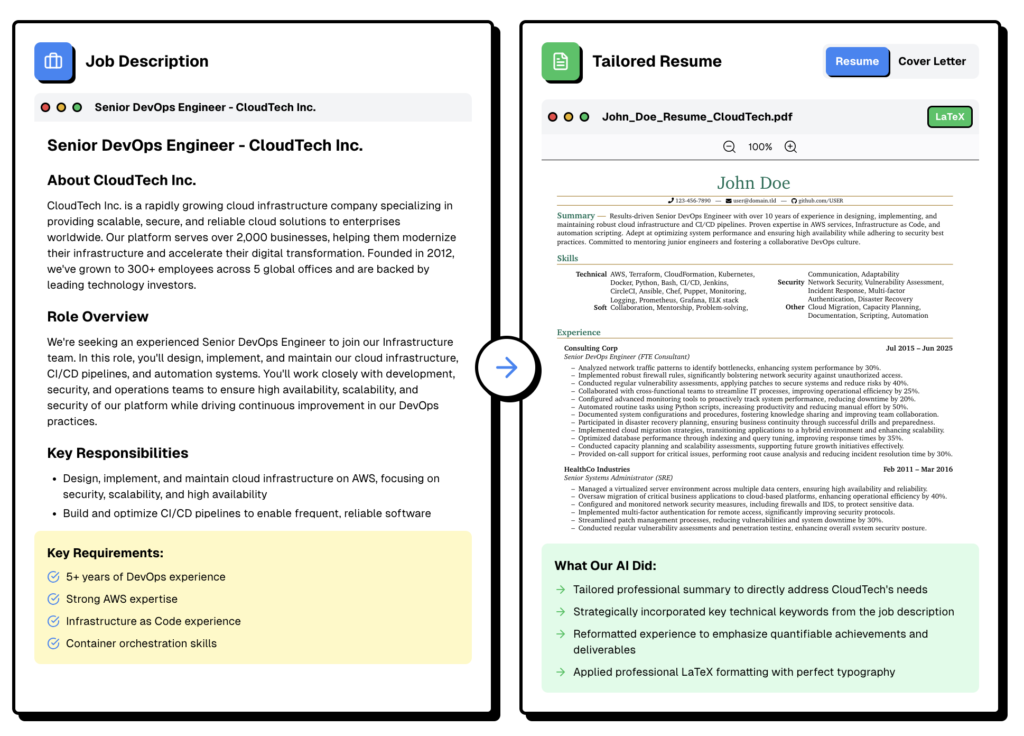
Now that you understand the importance of resume tailoring, let’s break down the exact process of how to tailor your resume for a specific job.
Step 1: Analyze the Job Description
Before you touch your resume, you need to deeply understand what the employer is actually asking for. This isn’t a quick skim—this is an intentional analysis.
Read the job description three times. On your first read, get the overall sense of the role. On your second read, start noting the specific skills, qualifications, and keywords that appear. On your third read, underline or highlight anything that appears more than once, appears in the job title, or appears in bold or emphasized text.
Create a list of:
- Hard skills mentioned (programming languages, software platforms, technical certifications)
- Soft skills emphasized (leadership, communication, problem-solving)
- Industry-specific terminology unique to the role or company
- Specific achievements or responsibilities they seem to value
- Qualifications they list as “required” vs. “preferred”
Pay special attention to the language they use. If they write “drove revenue growth” instead of “increased sales,” use their terminology in your resume. Language consistency signals that you’re already thinking like part of their team.
Step 2: Audit Your Current Resume
Now look at your existing resume. Identify sections where you can naturally incorporate the keywords and requirements you identified in the job description.
The goal is not to fabricate experience you don’t have—that’s a path to disaster during the interview stage and a potential cause for immediate termination after hire. Instead, you’re reframing and reorganizing your legitimate experience to emphasize what’s relevant to this specific role.
For example, if you worked in customer service and the job description emphasizes “problem-solving and communication,” you might expand your bullet point from “Handled customer inquiries” to “Resolved complex customer issues by asking clarifying questions and communicating solutions clearly, reducing repeat inquiries by 23%.” You haven’t changed what you did; you’ve contextualized it through their lens.
Step 3: Customize Your Professional Summary or Objective
Your professional summary is prime real estate for resume tailoring. This is where you set the tone for the rest of your application and immediately show relevance.
Instead of a generic summary like “Dedicated professional with 5 years of marketing experience,” you might tailor it specifically:
Generic: “Marketing professional with experience in digital marketing and brand management.”
Tailored: “Results-driven digital marketing specialist with 5+ years growing organic reach and managing brand positioning for B2B SaaS companies. Proven track record optimizing conversion funnels and leading cross-functional teams to exceed quarterly revenue targets.”
The tailored version directly mirrors language from the job description and immediately communicates why you’re a fit for this specific role.
Step 4: Reorganize and Reorder Your Experience
Most job seekers make a critical mistake: they present their work experience in the same order regardless of the job they’re applying for. Your most recent job might be irrelevant to the position you’re applying for, but if you put it first, that’s where the recruiter focuses.
Instead, reorder your bullet points to highlight the experiences most relevant to the job description. If you’re applying for a leadership role and your leadership experience is buried halfway through, move it up. If you’re applying for a technical role and you’ve been doing technical work that’s further down your resume, promote it.
The same principle applies to individual achievements. You might have 8-10 bullet points under a particular role. When tailoring for a specific job, keep the 3-5 that are most relevant to the position and remove or replace the others.
Step 5: Mirror Keywords and Qualifications
This is where being strategic about language becomes crucial. Look back at your keyword list from Step 1. Now scan your resume to see where you can naturally incorporate these terms.
If the job description emphasizes “data analysis” and you’ve written “analyzed reports,” change it to “performed comprehensive data analysis on quarterly performance reports.” If they mention “Agile methodology” and you’ve used it but not mentioned it, add it: “Collaborated with product team using Agile methodology to deliver features on accelerated timelines.”
This isn’t keyword stuffing—it’s ensuring your relevant experience uses the language your audience is using. Remember, both the ATS and human readers are looking for these terms.
Step 6: Adjust Your Skills Section
Your skills section should reflect the skills emphasized in the job description. If you have 20 skills listed, prioritize them based on the job posting. Move highly relevant skills to the top and remove skills completely unrelated to the role.
If the job heavily emphasizes certain software tools or methodologies you have experience with, make sure these appear prominently. If they mention tools you’re less familiar with but have some exposure to, you can include them—but only if truthful.
Step 7: Fine-Tune Your Achievements
Achievements matter more than responsibilities. Instead of describing what your job entailed, describe what you accomplished. When tailoring, select or reframe your achievements to demonstrate qualities the employer specifically values.
If they value efficiency and cost-saving, highlight achievements like “Reduced operational costs by 18% through process optimization.” If they value growth and leadership, emphasize achievements like “Built and mentored a team of 5 analysts, resulting in 40% faster project delivery.”
The same work experience can be presented through different lenses depending on the job you’re applying for. Your job is to choose the lens most relevant to this specific employer.
How to Use ChatGPT to Tailor Your Resume to a Job Description
With the rise of AI tools like ChatGPT, many job seekers are turning to artificial intelligence to streamline the tailoring process. Here’s how to leverage ChatGPT effectively for resume tailoring.
The ChatGPT Approach
ChatGPT can be a valuable brainstorming and editing tool, but it requires the right prompting to be truly useful. Here’s an effective process:
Step 1: Provide Context
Give ChatGPT your resume, the job description, and specific instructions:
“Here is my current resume [paste resume]. Here is the job description I’m applying for [paste job description]. Please identify 10 keywords from the job description that I should emphasize in my resume. Then suggest how I can reframe my experience to align with this role.”
ChatGPT will analyze both documents and provide targeted suggestions for keywords and reframing opportunities.
Step 2: Request Specific Customizations
Rather than asking ChatGPT to rewrite your entire resume, ask for specific improvements:
“My current professional summary is [insert summary]. Rewrite it to emphasize [key requirements from job description] while keeping my authentic experience and voice.”
This approach ensures ChatGPT enhances rather than fabricates your qualifications.
Step 3: Validate Against Job Description
After ChatGPT suggests changes, cross-reference them against the original job description. Does the suggestion align with what the employer actually asked for? Does it feel authentic to your actual experience?
ChatGPT’s Limitations
While ChatGPT is helpful, it has significant limitations for resume tailoring. The AI may miss subtle context about your industry or role, potentially suggesting changes that don’t make sense for your specific situation. ChatGPT can also sometimes make your resume sound overly formal or generic—lacking the personality and specificity that makes applications stand out.
Moreover, ChatGPT cannot independently verify that your claimed skills are accurate or relevant, so you’re responsible for ensuring suggestions are truthful and appropriate.
Why CVnomist Outperforms ChatGPT for Resume Tailoring
While ChatGPT is a powerful general-purpose tool, it wasn’t specifically designed for resume tailoring and comes with inherent limitations. CVnomist, by contrast, is purpose-built for this exact task. Where ChatGPT requires multiple prompts, back-and-forth refinement, and manual verification, CVnomist automatically analyzes both your resume and the job description in a single workflow, generating an optimized, ATS-ready tailored resume in under 60 seconds. CVnomist understands resume formatting requirements, ATS compatibility, and industry-specific keyword optimization in ways ChatGPT simply cannot. You don’t need to fact-check its suggestions or worry about fabrication—CVnomist works with your existing experience and emphasizes what’s genuinely relevant. The result is a professionally tailored resume that’s ready to send, not a rough draft requiring additional refinement and decision-making on your part.
How to Tailor a Specific Resume Type: The Data Analyst Resume Example
Resume tailoring principles remain constant, but certain roles benefit from industry-specific strategies. Let’s examine how to tailor a data analyst resume to job descriptions, as a practical example.
Understanding the Data Analyst Job Market
Data analyst job descriptions typically emphasize specific technical tools (SQL, Python, Tableau, Power BI, Excel), analytical methodologies, and business acumen. They also value specific competencies like data visualization, problem-solving, statistical analysis, and the ability to translate data insights into actionable business recommendations.
Tailoring a Data Analyst Resume: Specific Strategies
Emphasize Technical Proficiencies
Data analytics is a technical field. Make sure your programming languages and data visualization tools are prominently displayed and match those mentioned in the job description. If they mention “SQL optimization” and you have this skill, ensure it appears in your skills section and is backed up with specific examples in your experience, not buried in a single bullet point.
Quantify Your Impact
Numbers are the currency of data analysis. When tailoring your resume, ensure every achievement is quantified and tied to business outcomes. Instead of “Analyzed sales data,” write “Analyzed 18 months of sales data across 47 product categories using SQL and Python, identifying underperforming segments and recommending pricing adjustments that increased revenue by $2.3M.” Instead of “Created dashboards,” write “Built 12 interactive Tableau dashboards tracking KPIs for executive leadership, reducing monthly reporting time from 20 hours to 2 hours.”
Highlight Problem-Solving and Insight Generation
If the job description emphasizes translating data into business decisions, reframe your experience through that lens. Don’t just describe what analysis you did; describe what actionable insights resulted and how they impacted the business. If you’ve identified trends, led A/B tests, or optimized processes using data, emphasize that impact prominently.
Match Their Tools and Technologies
If the job description emphasizes specific programming languages or platforms, make sure you mention your proficiency explicitly. Don’t assume “data analysis tools” is sufficient—say “SQL (advanced),” “Python (pandas, NumPy),” or “Power BI” specifically. If the job mentions a tool you’re not proficient in but have exposure to, you can mention learning capability, but never misrepresent your skill level.
Tailor Your Technical Certifications
If you have relevant certifications (Google Data Analytics Certificate, Microsoft Certified, etc.), ensure they’re prominently placed for this type of role. If you mention programming languages or tools they’ve emphasized, link these to specific projects or certifications demonstrating your proficiency.
The Hidden Exhaustion: Why Tailoring Consumes Your Time and Mental Energy
Here’s what nobody tells you about resume tailoring: it’s absolutely draining.
When you’re serious about your job search, you understand the intellectual case for tailoring. You know it works. You know it increases your callback rate. So you sit down and commit to doing it properly—reading the job description, analyzing keywords, reframing your experience, adjusting your summary, reorganizing bullet points, fine-tuning language.
And it takes an hour. Minimum.
If you’re applying to five jobs in a week, that’s five hours. Five hours that could be spent actually networking, learning new skills, interviewing, or, frankly, sleeping after a long day of work.
But there’s something deeper happening here than just time loss. Each customized resume becomes personal. You’re not just submitting an application; you’re investing an hour of intentional thought into whether you’re right for this specific role. You’re researching the company, understanding their needs, positioning yourself as the perfect fit.
And then silence.
No response. No interview request. The application disappears into the void, and you never hear back.
When this happens repeatedly—and it happens to almost everyone—that emotional attachment becomes painful. You invested so much time, so much thought, so much hope into each customized application that the rejection (or more accurately, the non-response) feels personal. You start second-guessing your strategy. Were you too aggressive? Not aggressive enough? Did you miss a keyword? Is there something wrong with your experience?
The mental load of resume tailoring becomes a form of job search burnout. You’re emotionally invested in each application in a way that makes the silence from employers feel like accumulating rejection.
The Solution: Reclaim Your Time and Emotional Energy
This is where the mathematics of job searching changes dramatically. If resume tailoring typically takes an hour but you could do it in 60 seconds, what would that mean for your job search?
It would mean applying to 10 jobs instead of 5 in the same time investment. It would mean keeping yourself emotionally detached from each application because you’re applying at scale—you’re playing the numbers game rather than betting everything on each individual customization.
This is exactly why tools like CVnomist exist. Instead of spending an hour manually tailoring each resume, CVnomist uses AI to analyze your resume and the job description, then automatically generates a tailored version in under 60 seconds.
The process is remarkably simple: Upload your resume, paste the job link, and download your customized resume in literally 3 clicks. The AI analyzes both your background and the job requirements to identify matching skills, qualifications, and keywords—then generates an ATS-optimized resume that emphasizes your most relevant experience for that specific role.
Bonus Tip: For Job seekers preparing for video interviews or phone screenings after using CVnomist to land interviews, investing in quality audio equipment matters. Many professionals turn to resources like a best ANC headphones guide to choose models that enhance interview clarity, minimize background noise, and create a more focused home office environment where every response comes through clean and confident.
What Changes When You Automate Tailoring
When tailoring moves from a one-hour manual process to a 60-second automated process, everything shifts:
You apply to more opportunities. What was taking 5 hours for 5 applications now takes 5 minutes for 50 applications. You can cover more ground, apply to more roles that align with your career goals, and increase your statistical likelihood of landing interviews.
You stop getting emotionally attached to each application. When you’re applying strategically at scale, individual non-responses don’t sting as much. You’re not invested an hour into each one; you’re invested 60 seconds. This psychological shift is more important than it sounds. It keeps you resilient through the job search process and prevents the despair that comes from repeated rejections.
You maintain consistent quality. A tool like CVnomist ensures every resume you send is properly optimized for ATS and genuinely tailored to the job description—not a rushed version because you’re running out of time or energy.
Your callback rate increases. Because you’re applying to more jobs, and each application is properly tailored, you’re not just maintaining your interview rate—you’re multiplying it.
The math is straightforward: More applications + better optimization + emotional resilience = significantly better job search outcomes.
How AI Resume Tailoring Handles the Technical Details
When you use a tool like CVnomist, the AI is doing several things simultaneously that would take you substantial time:
The AI reads your resume and extracts your key skills, experiences, and achievements. It simultaneously analyzes the job description to identify must-have skills, preferred qualifications, and industry-specific terminology. It then maps your experience against the job requirements, identifying what’s relevant and what should be emphasized.
The tool generates a new version of your resume that reorders your experience to highlight the most relevant roles and achievements, incorporates keywords from the job description using natural language, optimizes formatting for ATS parsing, and maintains truthfulness—it doesn’t fabricate skills you don’t have or exaggerate what you’ve actually done.
The result is a resume that looks like you spent an hour customizing it, but that you created in under a minute.
Best Practices for Resume Tailoring Across All Approaches
Regardless of whether you’re tailoring manually or using automation, certain principles remain constant.
Never Fabricate Experience
This is the non-negotiable rule. Every claim on your resume must be truthful. You’re reframing and emphasizing authentic experience, not inventing qualifications you don’t possess.
Interviewers will probe into the details of what’s on your resume. If you’ve exaggerated or fabricated experience, you’ll be caught. Beyond the immediate embarrassment, you’re damaging your reputation and potentially making yourself unhireable at that organization or within your industry if word spreads.
Use Their Language
Mirror the terminology and phrasing from the job description. If they use “stakeholder management,” use those exact words rather than “client relations” or “vendor coordination.” If they emphasize “scaling operations,” incorporate that language if it applies to your experience.
This serves dual purposes: ATS systems are looking for keyword matches, and human readers recognize and respond to language consistency.
Prioritize Over Delete
When customizing your resume, reorder and reprioritize rather than completely removing experience sections. Someone who spent 3 years in a role still gained valuable skills even if that role isn’t directly relevant to this position.
Update Your Cover Letter Similarly
Your resume tailoring should be mirrored in your cover letter. If your resume emphasizes specific skills or experiences relevant to this role, your cover letter should explain why those experiences matter for this particular position.
A/B Test Your Approach
If you’re doing manual tailoring, experiment with different levels of customization. Try versions that are minimally adapted versus deeply customized, and track your callback rates. Data will tell you whether your time investment in tailoring is actually yielding better results in your specific field.
Save Templates, Not Full Resumes
If you find successful resume structures or phrasings that work well, save the language as a template for future use. This shortens future tailoring time and ensures consistency in what’s resonating.
Common Resume Tailoring Mistakes to Avoid
Mistake 1: Over-Customizing to the Point of Dishonesty
There’s a line between emphasizing relevant experience and fabricating qualifications. Staying on the correct side of that line is essential.
Mistake 2: Generic Tailoring
If your customization only involves swapping one job title for another, you’re not really tailoring. Genuine customization goes deeper—to the language, achievements, and emphasis of your background.
Mistake 3: Ignoring the “Nice to Have” Qualifications
While it’s fine to focus on “required” qualifications, don’t completely ignore “nice to have” or “preferred” qualifications. If you have experience with something listed as preferred, include it. These can be the differentiators that set you apart from other candidates.
Mistake 4: Tailoring Without Proofing
Rushed customization leads to errors. Always proofread your tailored resume before sending. Typos and grammatical errors undermine the impression that you’re detail-oriented and serious about the role.
Mistake 5: Not Tailoring At All
Finally, the biggest mistake is deciding that tailoring isn’t worth the effort. In a competitive job market, this decision will cost you interviews.
The Future of Resume Tailoring: Automation as Standard Practice
The job search landscape is shifting. As more candidates adopt resume tailoring as standard practice, employers’ expectations are rising. They expect applications to be customized. Generic resumes are increasingly seen as lazy or uncommitted.
Simultaneously, AI tools are making tailoring easier and faster than ever. What used to require an hour of manual work now takes seconds. This means that candidates who don’t use these tools are at a disadvantage—they’re spending an hour doing what others are accomplishing in 60 seconds.
The optimization imperative has shifted. It’s no longer “should I tailor my resume?” but rather “how can I tailor my resume most efficiently?”
Tools like CVnomist represent this shift. They acknowledge that while resume tailoring is important, your time is valuable. By automating the technical work of analyzing job descriptions, identifying keywords, and restructuring your resume, these tools let you focus on what actually matters: finding roles that align with your career goals and putting your best foot forward.
Conclusion: Strategic Tailoring for Better Results
Resume tailoring isn’t optional in today’s job market—it’s essential. The question isn’t whether to tailor your resume for each job; it’s how to do it efficiently without sacrificing the quality of your applications or your sanity in the process.
A tailored resume passes through ATS filters more effectively, appeals more directly to human readers, and signals to employers that you’ve done the intellectual work to understand their needs. The data consistently shows that tailored resumes generate significantly higher interview rates than generic applications.
Whether you’re manually tailoring your resume using the step-by-step process outlined in this guide, using ChatGPT to brainstorm and refine, or leveraging AI tools like CVnomist to automate the process entirely, the principle remains constant: customize your resume to each role.
For job seekers looking to balance quality with efficiency, automation is increasingly the answer. When you can go from generic resume to perfectly tailored application in under a minute, you can apply to more jobs, maintain your emotional resilience through the job search, and increase your statistical likelihood of landing interviews.
The job market rewards strategy and efficiency. Resume tailoring—done right—gives you both.


Permalink